|
CLICK HERE TO VIEW SELECTION OF PRINTS
Prior to World War I, Lehmbruck was included in many important exhibitions. In 1912, he exhibited with Egon Schiele at the Folkwang Museum in Hagen. Later that year, his watercolors and sculpture were featured in that museum's Moderne Kunst exhibition thereby demonstrating his abilities as a two-dimensional artist as well. He was also featured in the 1912 Westdeutscher Sonderbund International exhibition which included works by Van Gogh, Cézanne, Gauguin, Munch and Picasso. His sculptures also traveled to the famous 1913 Armory Show in New York. When World War I broke out in the summer of 1914, Lehmbruck left Paris and became a medic for the German army. Due to this horrifying experience, he began to create male rather than female figures. These figures were symbols of the war dead and in particular the fate of European youth at the time. His famous sculpture, The Fallen Man, influenced Max Beckmann with whom he joined the New Freie Sezession. Despite his artistic notoriety, Lehmbruck committed suicide in 1919. Graphic works by Lehmbruck often relate to his sculptures. Signed works by the artist are rare as most bear the Estate stamp due to his untimely and unexpected death. His sculptures are in the collections of the National Gallery of Art in Washington, DC and the Museum of Modern Art in New York. |

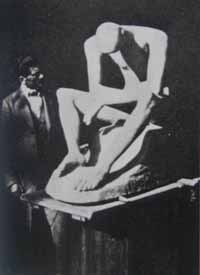 Wilhelm Lehmbruck (1891-1919)