|
CLICK HERE TO VIEW SELECTION OF PRINTS
For the next twenty years, he style shifted slightly from late Naturalism to show an awareness of Impressionism but it was in 1901 that his style changed radically. It was then that he was offered a post at the newly founded Folkwang Museum in Hagen. Due to the great collection of French Impressionist paintings there, he was led toward Pointillism and then towards a style closely modelled after Van Gogh. In 1910, he made his first prints while in Munich where he focused on the figure rather than landscape. In 1912, he returned to Hagen where he would remain for the rest of his life. In 1919, at the age of seventy, he finally achieved national success with an exhibition at the Nationalgalerie in Berlin. He also got married for the first time that year. It was only at this later stage of his life that he revealed his talent as a colorist when he worked in watercolors rather than oils and to flower and landscapes rather than religious themes. In 1937, the Nazis declared his art "degenerate" and expelled him from the Berlin Akademie der Künste. He produced 168 woodcuts, linocuts and stencil prints and well as a number of book plates all executed between 1910-1926. Each print is unique as he employed many curious and unusual features. (Paraphrased from The Print in Germany: 1880-1933. By Frances Carey and Antony Griffiths). |

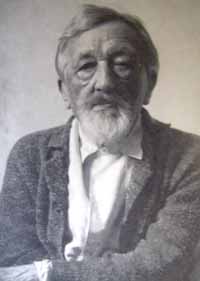 Christian Rohlfs (1849-1938)